Lead response is your clinic's ability to connect with a patient who calls to book, from the moment the phone rings to the moment the visit is in the calendar. Good lead response means a person or an AI voice agent picks up fast, understands what the patient needs, and completes the booking without a callback or a dropped line.
That first contact attempt is where a patient quietly decides whether your clinic is reachable. Miss it, and most of them do not try again. They call the next clinic on the list.
Key takeaways
- Lead response covers two jobs: answering the patient call and finishing the booking. Both have to happen for the lead to count.
- In instadial's 2026 study of 46 Latvian clinics, 65.2% connected the caller to a person who booked, 21.7% hit an IVR or busy line, and 13% did not answer at all.
- A clinic taking 1,000 calls a month and missing 13% of them loses about EUR 6,720 a month, by instadial's 2026 calculation.
- A practical pickup target is under 3 seconds; measure answer rate, response time, booking completion and abandonment separately by channel.
- These practices fit routine appointment booking. They do not replace emergency triage or complex clinical assessment.
What Is Lead Response in Healthcare Clinics?
Lead response in a healthcare clinic is how quickly and how completely you connect with a patient who contacts you to book. It has two parts: answering the call, and finishing the booking while the patient is still on the line. Only doing the first part is a half-answer.
Think of a mother calling three family clinics on a Tuesday evening to find a pediatric slot. The one that picks up, checks the calendar, and gives her a time wins the patient. The other two get a voicemail she will never hear back from.
This is the clinic's first impression, made before anyone sees a doctor. A lead here is a prospective patient inquiry, which is different from someone already in active clinical care. Marketing-style inquiries can be automated more freely; anything involving symptoms or medical detail needs privacy and escalation controls.
Why Lead Response Time Matters for Patient Conversion
Lead response time matters because clinics lose patients who never reach a human or who wait too long, and those patients rarely call twice. The money leaks quietly, one unanswered ring at a time.
According to instadial's 2026 study of 46 Latvian clinics, 13% did not answer the first call. For a clinic taking 1,000 calls a month and missing that same 13%, instadial's 2026 calculation puts the loss at about EUR 6,720 a month in patients who simply move on. That is a measurable hole, not a soft worry. We covered the full breakdown in why Latvian clinics lose patients to missed calls.
Speed-to-lead evidence from outside healthcare points the same direction. The 2007 MIT and InsideSales Lead Response Management study of more than 15,000 sales leads found that waiting 30 minutes instead of 5 minutes to respond cut the odds of qualifying a lead by roughly 21 times. That is sales data, not a clinic benchmark, but the pattern holds: slow contact loses people.
What Inbound Lead Response Time Actually Measures
Inbound lead response time measures the interval between a patient reaching out and a real person, or an AI voice agent handling the booking, picking up. It is a stopwatch on the gap between the ring and the answer, nothing more.
It is not the same as appointment scheduling time. Scheduling time measures how long the booking conversation takes once contact is made. Response time measures how long the patient waited to be reached in the first place. A clinic can book fast yet still lose people to a long wait before pickup.
A practical pickup target is under 3 seconds. According to instadial, its AI voice agent picks up a patient call in under 3 seconds and the average call lasts about 3 minutes. Measure each channel on its own. Slow response times cost businesses real revenue, and phone is where the losses hide.
How Clinics Currently Handle Incoming Calls
Clinics handle incoming calls in three ways, and the spread is wider than most owners assume. instadial called 46 Latvian clinics in 2026 to test how easily a patient can actually book by phone, and the results sorted into three outcomes.
- Connected to a person who booked. Share of clinics (2026): 65.2%; What the patient experienced: A human answered and completed the booking
- IVR menu or busy line. Share of clinics (2026): 21.7%; What the patient experienced: An automated menu or an engaged tone, no booking
- No answer at all. Share of clinics (2026): 13%; What the patient experienced: The first call went unanswered
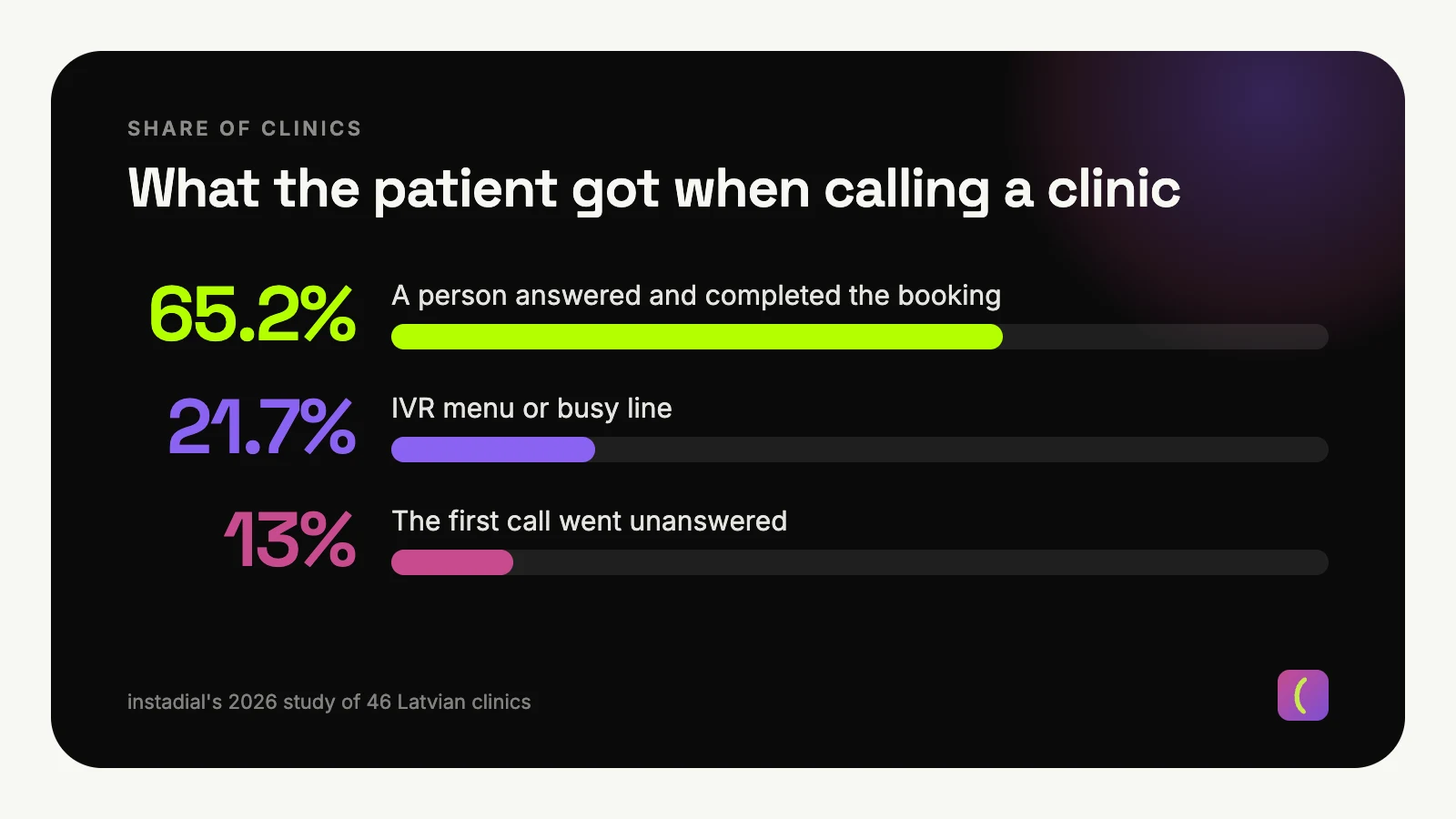
According to instadial's 2026 study, 65.2% of clinics connected the caller straight to a person who booked the visit, 21.7% answered with an IVR menu or a busy line, and 13% did not answer the first call. The middle group matters: an IVR or a busy signal is not a win, because the patient still has not booked. Roughly a third of clinics left callers somewhere between frustrated and gone.
The Six Practices That Speed Up Lead Response
Six concrete practices move the needle on lead response for a clinic. Each one closes a specific gap the 2026 study exposed, and they stack: do several and the answer rate climbs.
- Staff scheduling matched to call volume, so there are enough people on the phone when patients call.
- Call routing to booking-ready team members who can confirm a slot immediately.
- IVR systems that gather basic information without adding delay.
- AI voice agents for 24/7 availability, picking up every call.
- Real-time integration with clinic management software.
- Call queuing that prevents dropped and abandoned calls.
The sections below take each in turn. None of them requires ripping out your phone line or replacing your front desk. instadial is the front desk's always-on colleague, not a stand-in for the people who run it.
Practice 1: Staff Scheduling Matched to Call Patterns
Matching staff schedules to call patterns means putting more people on the phone during the hours patients actually call. Most clinics under-staff for phone demand because they schedule around clinical hours, not call volume.
Pull a month of call logs and look at when the ringing clusters. For many clinics it is Monday mornings and the hour after lunch. Evenings matter too: someone calling an optics store at 19:00 is a real buyer, and if nobody picks up, they are gone.
Staff those peaks first. The trade-off is obvious: you cannot hire a receptionist for every spike, and quiet afternoons do not justify a second phone line. That gap between demand and what you can reasonably staff is exactly where the later practices, especially an AI voice agent, do the heavy lifting.
Practice 2: Call Routing to Booking-Ready Team Members
Call routing to booking-ready team members means sending each call to someone who can see the calendar and confirm a slot on the spot, not someone who has to transfer it. Every transfer is a moment the patient can hang up.
The failure mode is familiar. A caller reaches reception, reception cannot see the specialist's availability, the call bounces to a second person, and halfway through the patient gives up. Each handoff adds wait and adds risk.
The fix is to route calls to staff who already have clinic management software access and the authority to book. For multi-branch networks, that also means routing by branch, specialty and language, so a Russian-speaking caller in one branch is not stuck with staff who cannot help. Fewer hops, faster booking, fewer lost leads.
Practice 3: IVR Systems That Gather Data, Not Frustrate
A good IVR gathers useful information while the patient waits, instead of trapping them in menu trees. The point is to shorten the human conversation that follows, not to replace it with a maze.
An intelligent menu can capture the reason for the visit, the branch, or insurance details before a person picks up. When the receptionist answers, that context is already there, so handle time drops. That is the difference between an IVR that helps and one that irritates.
The limit is real. In the 2026 study, 21.7% of Latvian clinics answered with an IVR or a busy line and the caller still did not book. An IVR that only parks people is a dead end. Keep menus to one or two layers, never ask for sensitive medical detail through an automated prompt, and always route to a human or an AI voice agent that can finish the booking.
Practice 4: AI Voice Agents That Answer Every Call
An AI voice agent is a system that answers the phone in natural language, understands what the patient needs, checks live clinic availability, and books the visit directly into your software. It does not sleep, take lunch, or put callers on hold during a rush.
This is the practice that covers the hours and the volume humans cannot. According to instadial, its AI voice agent can hold up to 100 phone calls at the same time, picks up in under 3 seconds, and speaks Latvian, Russian and English. It books, reschedules and cancels visits, answers common questions, and routes urgent cases to staff with context. The Novoptika optics store has answered every after-hours and weekend call with instadial since June 2026 and gets a call summary each morning.
An AI voice agent is the clearest way to close the 13% no-answer gap without hiring a night shift. See how instadial's AI voice agent handles speed-to-lead for the mechanics.
Practice 5: Real-Time Integration with Clinic Management Software
Real-time integration means the person or AI agent answering the call can see the live schedule and write the booking straight into it, with no manual re-entry later. Without it, you get double bookings, phantom slots, and a patient told to wait for a confirmation that may never come.
According to instadial, since October 2026 its AI voice agent books, reschedules and cancels visits directly in the IS Ārsta Birojs clinic system, which removes the manual data-entry delay between taking a call and recording the visit. instadial also syncs with Google Calendar, Outlook, Calendly, Cal.com, and with Salesforce, HubSpot and Zoho. We wrote up the IS Ārsta Birojs integration in detail.
One honest limit: instadial does not sell the clinic management software itself. It books into the system you already run. On Salesforce specifically, no verified healthcare lead-response benchmark exists; vendor pages like the Simplyhealth customer story describe single implementations, not a clinic standard.
Practice 6: Call Queuing That Prevents Abandonment
Call queuing holds callers in line when every agent is busy, instead of dropping them to a dead tone. The difference between a queue wait and a no answer is the difference between a patient who waits 40 seconds and one who is gone for good.
A queue with a clear message, telling the patient their place or offering a callback, keeps the lead alive. A busy signal throws it away. In the 2026 study, the 21.7% who hit a busy line were effectively unqueued: no holding, no callback, no booking.
The stronger version pairs queuing with an AI voice agent that picks up overflow so the queue rarely forms. When a human line is full, instadial answers rather than letting the call die. For any genuinely urgent symptom, the agent routes to staff rather than holding the patient in a queue, which is a safety rule, not a convenience.
When Lead Response Best Practices Stop Working
These practices stop working when the call is not a routine booking. They are built for appointment scheduling, and they are not a substitute for clinical judgment.
They do not cover emergency triage. A patient describing chest pain needs a clinician or emergency services, not a booking flow. They do not cover complex diagnostic calls where a doctor must assess symptoms before any appointment type even makes sense. And they do not fit clinics where nearly every call requires a multi-minute clinical conversation before a slot can be offered.
For those cases, the right design routes the call to a qualified human fast and with context, which is what triage and routing are for. instadial escalates urgent cases to staff rather than trying to resolve them. If your call volume is low and a single receptionist already answers every call on the first ring, you may not need more than good scheduling. Be honest about which bucket your calls fall into before buying anything.
How to Measure Your Clinic's Current Lead Response
Measure your clinic's lead response with four numbers, tracked by channel rather than lumped together. Aggregating phone, web form and after-hours calls hides exactly the failures you need to find.
- Answer rate: the share of calls that reach a person or an AI agent that can book. The 2026 study's combined human-plus-booking figure was 65.2%.
- Average response time: how long callers wait before pickup. Aim for under 3 seconds on the first ring.
- Booking completion rate: the share of answered calls that end in a booked visit, not just a conversation.
- Abandonment rate: the share of callers who hang up before reaching anyone.
The practical first step is to audit yourself the way instadial audited 46 clinics in 2026: call your own lines at different hours, in different languages, and record what happens. You will find your gaps in an afternoon. instadial ran pilots in more than 10 Latvian clinics in 2026 and sets up on your existing phone line in about a day. Pricing starts at EUR 49 a month plus EUR 0.39 per conversation minute, with onboarding from EUR 900, excluding VAT. See the instadial AI voice agent for clinics and the instadial FAQ for the full detail.
FAQ
What is a good inbound lead response time for a clinic?
A practical target is picking up in under 3 seconds and completing the booking on the same call. There is no verified Latvia-wide healthcare benchmark, so measure your own answer rate and response time by channel rather than copying a number from another industry. According to instadial, its AI voice agent picks up in under 3 seconds and the average call lasts about 3 minutes.
Is the 5-minute lead response rule a healthcare standard?
No. The widely quoted 5-minute and 21-times figures come from the 2007 MIT and InsideSales study of more than 15,000 sales leads, not from clinics. Treat it as directional evidence that fast contact wins, not as a medical benchmark. Set an SLA your clinic can actually staff, with the fastest workflow reserved for missed phone calls.
What did instadial's 2026 Latvian clinic study find?
instadial called 46 Latvian clinics in 2026 to test phone booking. 65.2% connected the caller to a person who booked, 21.7% answered with an IVR or a busy line, and 13% did not answer the first call. instadial's 2026 calculation puts the loss for a clinic taking 1,000 calls a month and missing 13% at about EUR 6,720 a month.
Does an AI voice agent replace front-desk staff?
No. An AI voice agent answers calls staff cannot reach, such as peaks, evenings and weekends, and routes urgent cases to people with context. instadial is the front desk's always-on colleague. It handles routine booking so your team can focus on patients in the clinic, and it escalates anything clinical or urgent to staff.
What languages and systems does instadial support?
According to instadial, its AI voice agent speaks Latvian, Russian and English. It books directly into IS Ārsta Birojs since October 2026 and syncs with Google Calendar, Outlook, Calendly, Cal.com, Salesforce, HubSpot and Zoho. instadial does not sell telephony, clinic management software or human call-centre staff; it works on the phone line and systems you already use.